
Marketing Strategy Planning for your Virtual Assistant Business
It’s vital in putting your business on the map
What possibly can be the difference?
Well, there might be many reasons, but having the correct focus and effective marketing strategies that are tailor-made for your situation, might just be the answer.
Below we will show you the basics of developing a marketing strategy for small business, that WORKS!
But first, let’s start at the beginning.
What is Marketing Strategy Planning
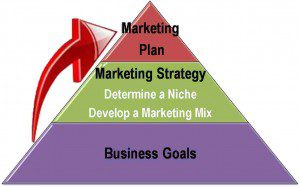
Marketing strategy planning is a process that allows you to focus your limited resources on the best opportunities to increase your sales and thereby achieving a sustainable competitive advantage in your specific niche.
It is the way to make sure you’re getting the maximum impact from your limited marketing budget and time.
Your marketing strategy is always build on your business goals, and provides the foundation for your marketing plan (the detailed marketing activities that you will do) .
Thus your marketing strategy planning will direct all your marketing activities.
Marketing Strategy Planning in 8 Easy Steps
1. Evaluate your Current Situation
Evaluate your current situation critically and determine if there are any problems that need to be solved and/or if there are any opportunities that you would like to explore?
Some examples are
- your income is declining
- your income aren’t growing as fast as you would like
- you have just lost some key accounts to competitors
- you want to expand your services into a new client base
- you think there is a market for a new service
- you wish you could get through to more customers on just how good your services are
2. Address the Issues / Opportunities that Arise to Grow your Business
After careful evaluation of your current situation decide on the best strategy to address the situation to grow your business.
It can be done through any of the following strategies.
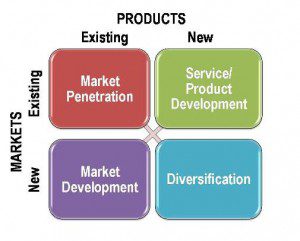
A: Current service to current market (Market Penetration): It is a strategy to increase your share of your existing markets. You might achieve this by raising the awareness among your current customers’ of your services or finding new customers.
B: Current service to new market (Market Development): It is a strategy of finding and entering new markets with your current service range. The new market could be a new region/country or a new segment of the market. For example: You’ve been doing database management for financial advisors in your home town only. You’ve realised that financial advisors all over South Africa have the same need and you want to reach them as well; or you’ve realised that business coaches in SA has a need for somebody to maintain their databases and you want to tap into that new market segment.
C: New service to current market (Service/Product Development): It is a strategy for enhancing the benefits you delivers to your clients by improving your existing services or developing new ones. For Example: You deliver the services of database management to a number of clients. You now want to expand your services to also do cold calling for these clients to help them reach the people on their database on a more frequent basis.
D: New service to a new market (Diversification): It is a strategy that usually carries higher costs and higher risks. It often requires you to adopt new ways of doing business.For example: You’ve been doing only administrative tasks for clients. Now you want to start doing web design and search engine optimisation for new VAs entering the industry.Diversification can sometimes be an effective business strategy, but needs good planning and some caution. It is usually a strategy to adopt when the other options are not feasible.
3. Understand Your Customer
Successful marketing strategy planning is based on a clear picture of your target customer – Who they are and what they need.
To understand your customer, use the tips as explained under what is a target marketand how to identify a target market to gain some insight into your customer’s profile and to identify the issues that might keep them awake at night.
How can your services be of benefit to them?
4. Analyze the Competition
Ask yourself what other choices your target customers have to address their administrative needs.
Your main competitors will most probably be other VAs with services that are very similar to yours. But it can also be other companies/and or persons, for example in-house secretaries, temporary staffing companies etc. that can also address the needs of your target customer.
Evaluate and assess the strengths and weaknesses of each of these competitors when doing your marketing strategy planning.
5. Create your Unique Selling Proposition
Now, consider the ways in which your service is better than those supplied by your competition at solving the needs of your target customer. This is your Unique Selling Proposition (USP)
Use your Unique Selling Proposition (USP) as a short, but strong message to your target market to entice them in making use of your services.
6. Define Your “Marketing Mix”
At this stage, your marketing strategy planning helped you to determine how to grow your business; determined your target market and their needs, analysed your competition and developed a Unique Selling Proposition.
Now it is time to develop your “Marketing Mix” – the unique variables that you have control over to satisfy the needs of your target market. The marketing mix is also called the 4P’sof marketing and consists of
Product: (your VA Services): The right services for your target market
Price: The right price for your services. Take in consideration pricing strategies of your competition, your expenses and your desired profit
Promotion: How you will tell your target customer about your services
Place: How you will deliver your services to your target customer. E.g. will you perform all the services yourself, or will you outsource some services to other VAs.
7. Keep an Eye on Your Budget
Evaluate how much you will be able to spend on marketing your services on a monthly basis.
8. Review and Revise
Continuously evaluate the effectiveness of your marketing strategy, and revise or extend as needed.
Develop your Marketing Plan
The difference between a marketing strategy and a marketing plan is:
Your Marketing Strategy is a summary of your businesses services and position in relation to your competition; Your Marketing Plan is the specific actions you’re going to undertake to achieve the goals of your marketing strategy.
Marketing Strategies provide the goals for your marketing plans. It tells you where you want to go from here. Your Marketing Plan is the specific roadmap that’s going to get you there.
Thus, your marketing plan flows directly from your marketing strategy and in effect, you can’t have a marketing plan without a marketing strategy.
Use strategy marketing planning to give you a competitive edge…it might just be worth the effort.
For more information read
How to identify your Target Market
What marketing details to include in a Virtual Assistant Business Plan
Effective Marketing Methods
FREE Video Training!
Get a PROVEN plan to start a profitable VA business
More Training & Resources to Get Started

Become a Virtual Assistant and turn your current skills and experience into a profitable career
Here are some more keys to success.
Click on the links below to read more…